Tech theology: “Life in abundance”. On digital freedoms and the search for the good life…
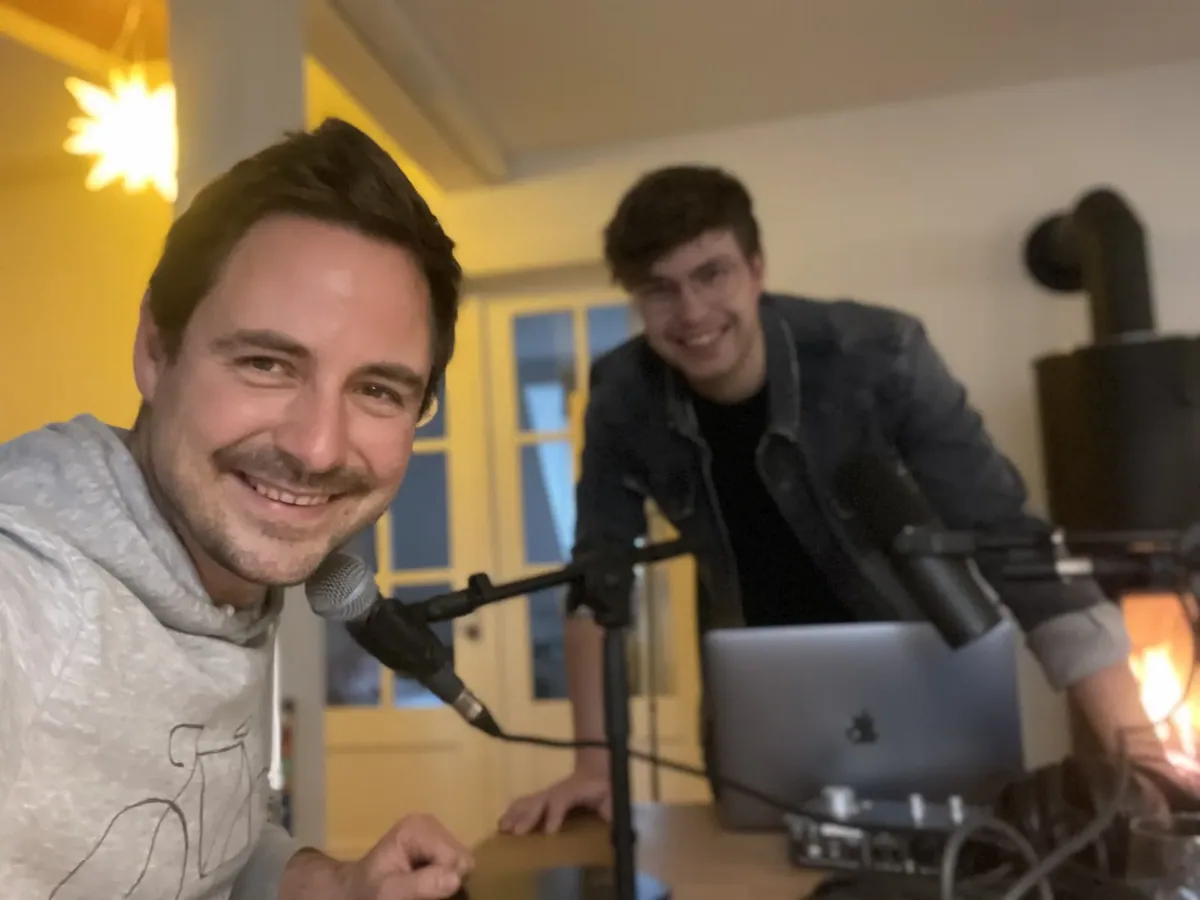
On what theology and IT share at their core: digital freedom, longing and the search for meaning. Digital deacon Josef John talked about this and much more. His conversation partner: Jan Otte, a probationary pastor in Konstanz.
Listen to this episode
Also on: Spotify · Apple Podcasts · podcast.de
Josef: You worked in IT for many years and clearly have a knack for technology. And now you are a pastor, or more precisely a “probationary pastor”. What do you do in that role?
Jan: Probationary service comes from civil service law. I already have all the exams and certificates I need to apply to a parish afterwards. I am more or less over the hardest part…
Josef: … so a lot would have to happen now, say pushing the organist off the bench or stealing the collection.
Jan: I value this security, combined with the prospect of working closely with very different people, aged 0 to 104 – I see that as a great privilege. Coming from my previous role as a manager of change processes, that is an infinitely large target group, a whole century in view! What a mammoth project.
Josef: You did a few rounds in business before you became a pastor. Tell us a bit more about that time – what shaped you…
Jan: At first it was quite simply about earning money, right from my first semester. Rents were already expensive back then, even in student halls. Around the turn of the millennium I started selling controlling software for an SAP spin-off. A practically invisible product, hardly tangible and not really sexy to this day. It was quite a challenge for sales to convey a sense of lifestyle to customers and to those who were yet to become customers.
Josef: And how did things go on for you from there, from a student job to a big strategy consultancy?
Jan: On the campus of Heidelberg University there were occasional workshops, hidden recruiting events. That is where I more or less let myself be poached by Accenture, one of the world’s largest consultancies for transformation processes. There I worked with psychologists and business educators. At the human-machine, machine-human interface. And that is quite useful for my current calling in the church, which of course is also going through upheaval…
The human-machine, machine-human interface
Jan Otte, tech theologian
Josef: Crazy how you slipped into that! It sounds as though becoming a manager was not exactly your very first plan. From swotting up on Hebrew and Greek to analysing Excel sheets. Why did you not stay there? I can imagine you earned plenty of money in the IT industry. How did the next change come about…
Jan: Theology is much more than an unprofitable art! And of course, in a management position in Switzerland I earned considerably more than I will ever earn in the public sector in Germany.
Josef: So it was not money that made you change again. What was it, then?
Jan: I changed because I really enjoy this! Out of conviction, passion and vocation. To stand in the midst of life as a Christian, in contact with people. To sense in our church kindergartens, schools and care homes what is currently going on across the breadth and depth of society. It matters a great deal to me to see people as a whole, with all their potential and needs.
Josef: Compared with your previous job as a consultant, do you still feel you have to sell something?
Jan: Less so in my job as a pastor. Of course there are strategies and concepts, such as “Church in Transition”, which have to be got across to people by 2023. That happens inductively. That way change comes from within, noticeably and without sales pressure. And please, not only in elite management circles and workshops.
Josef: Can you imagine going back into business?
Jan: Sadly, I do not have the gift of looking into a crystal ball either. There I trust in God! He oversees several futures at once. Much is possible AND conceivable. But about THE future I know little to nothing. Meanwhile I concentrate on the present. As the father of three small children, the grassroots work in our parish is really close to my heart! And they, just like my wonderful wife, give me a great deal of focus. I keep asking myself how we can live well together and what next steps we need for that, for this “life in abundance” (Gospel of John, chapter ten)
Josef: What I hear is that you think of church as bigger than its buildings, which are increasingly being converted and put to other uses. I sense that, for you, church means life to the full. Starting with the creation story, shaping life…
Jan: … we look together for ways for life to succeed! And process orientation from the world of IT helps us with that. As a form. The content is wonderful, and for me it comes from theology. It is the combination that does it for me. Becoming faster together. As an organisation, the church can learn a lot from agile start-ups! Shorter cycles, from design to MVP – “minimum viable product”. Low-threshold, if you please, and above all developed iteratively. That time when we as a church had a monopoly on know-how and every week proclaimed our superior authority to interpret the Gospel, exclusively from the pulpit – thank God it is over!
Josef: That sounds good, this willingness not only to keep starting something new but also to cut off old habits. And to see whether this or that initiative takes off. And if not, we scrap it again quickly…
Does the initiative take off? Otherwise we scrap it again quickly...
Josef John, digital deacon
Jan: I thought about this only recently with our governing body, the council of elders – the supervisory board of our parish, so to speak. What is church? And where does our mission lie? Which activities should we tackle straight away? What does that do to us! Right here, locally, in concrete terms. Being able, on this path, to let go of some things we have grown fond of. And what would we rather leave aside as followers of Jesus…
Josef: The church is a melting pot of traditions, preserving all sorts of things…
Jan: … and at the same time daring to try something new. Here in Konstanz we have the “Stadtwandel” (urban change) process, Fridays for Future and a growing urban gardening scene. I experience all of this as church within the community, outside entrenched structures. Basically nothing other than what Jesus did: going out, not writing much down, but talking to people all the more – as an agile coach! Touching people at eye level and being touched yourself.
Josef: Relevance to life arises where we have profound personal experiences – with God and the world and with people. And my faith decides what I make of this cocktail of experiences. How do we create these spaces for experience?
Jan: By setting out. Bravely, decisively and strongly! Simply trying and daring something again, even without 100-page concept papers. There is one thing I think is excellent right now and am working through with my students: “Digital Freedom”. The Ten Commandments in the digital age. For example the second: not to make an image of God. But what image does Google have of you?
Josef: Google, smartphones and algorithms. They did not exist at the time of the Reformation. But faith existed at all times, 500 years ago too…
Jan: … and today, just as then, we ask ourselves how faith can become tangible and something we experience in concrete terms, beyond the Bible stories! By the way, that is also what Mark Zuckerberg is trying to do with his metaverse.
Josef: With everything you have already achieved professionally, did you plan it all in such a straight line?
A career is anything but something you can plan in a straight line.
Jan Otte, father of three
Jan: A career is anything but something you can plan in a straight line. For me it is more like a ball of wool that, looking back, we try to untangle a little and pull into a straight line. That was my experience at a retreat with our bishop, where we were asked to present “person to person” our path to becoming pastors, the search for the common thread. Afterwards we can present it all like that, these individual stages.
Josef: I also think we can no longer think of God so narrowly, and certainly not of CVs! What makes you happy?
Jan: For my children’s baptisms I looked for special verses from the Bible. One of them is: “But it is good for me to draw near to God” (Psalm 73:28). And it goes further: “Thou hast set my feet in a large room” (Psalm 31:8). For me that fits virtual worlds of experience, but it goes much deeper than that! Deeper than many a transhumanist’s dream.
Josef: That makes me think straight away of Psalm 139, the idea that God surrounds us on all sides, the digital side included. For Moses it was the burning bush…
Jan: And Moses could not even speak properly. He needed assistance systems. Whether analogue or digital, left or right half of the brain, emotion or reason, plotted on a 3D printer or as a hologram. What matters to me is that we have special religious experiences; not permanently, but again and again! Especially at life’s transitions, in processes of transformation, change that is lived, change management.
Josef: Thank you very much for the conversation, Jan! And all the best for whatever comes next for you…
Cover image: (Michael Dziedzic/ Unsplash)
Translated from German by Claude. The episode audio is in German. Read the original in German.