Bregenzerwald: Family ties with a base camp on the Arlberg
A visit to the Schwarzmann family in Schröcken, a village of 200 inhabitants. In addition to their existing joinery, this year they built the Berghaus at an altitude of 1,300 metres. Now it is finished. Just in time for the start of the winter season, the people of the “Wald” have broadened their base. A village story.
Listen to this episode
Also on: Spotify · Apple Podcasts · podcast.de
Building a house – that was the very first plan, one for his own family, like dozens of other families in Schröcken. And then it became more in the life of Jakob Schwarzmann, 25. After primary and secondary school, then his school-leaving exams and his journeyman’s certificate as a joiner, with knowledge of interior design and house fitting in his rucksack. Just like his brother Paul, two years younger.
In the middle of the coronavirus lockdown, the brothers came up with plan B. And they were not alone. “Mum was all fired up from early on,” the two eldest report on how the project went. Their mother Steffi, 55, smiles. “At this stage of life you do not start a hotel any more, that is a project for the young ones.” Steffi brought in an external adviser, “for such a big step”.
From plan A to plan B
Their goal was to invest together as a family company. The four children were not to be overburdened by the construction. “The bank liked our concept of an accompanied generational handover. And in the end it signed it off quickly,” reports Steffi, a trained travel agent.
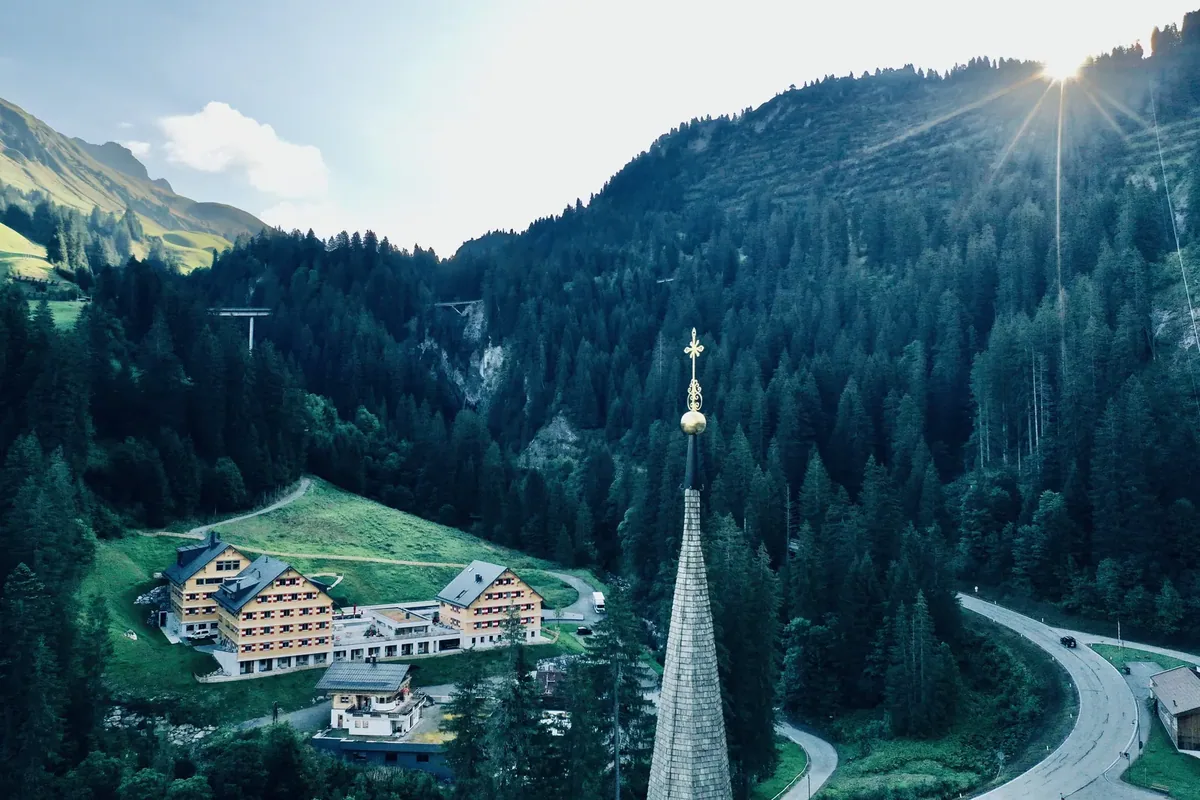
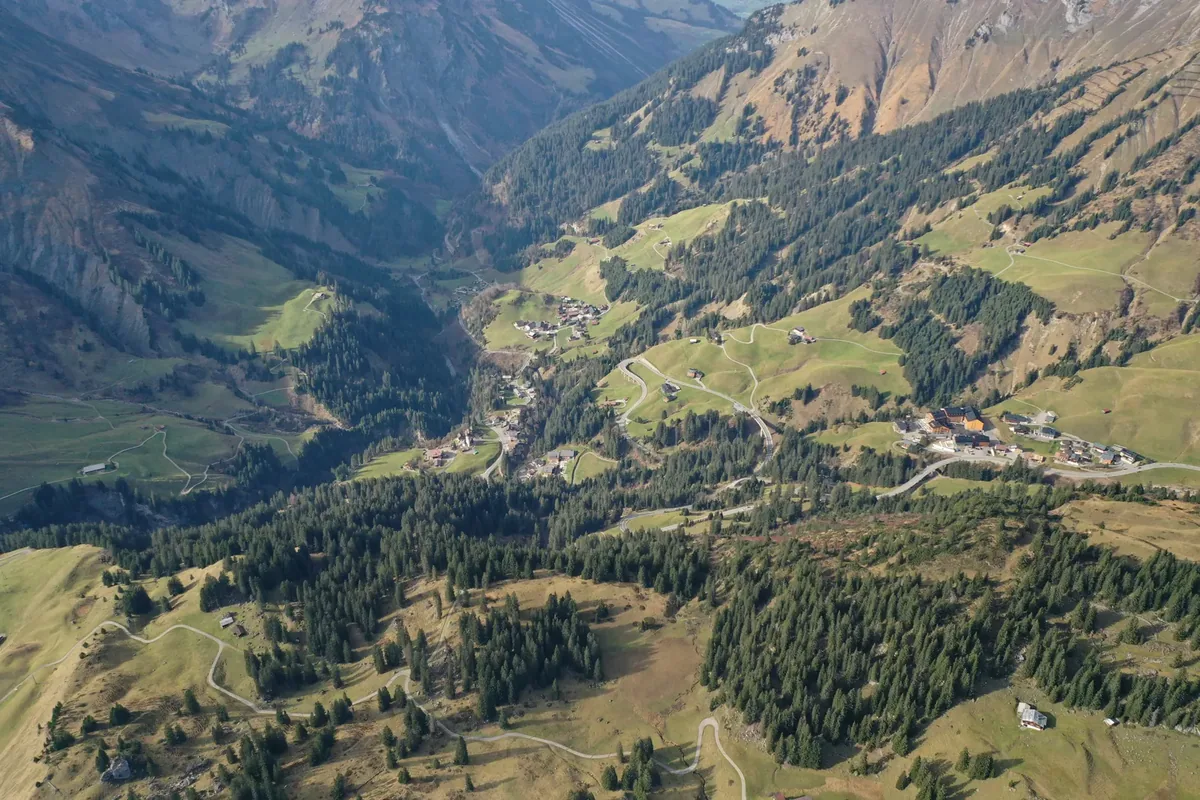
Last spring things finally got going: the financing in place, everyone on board, the most important questions settled – excavation, laying the foundations and building work. Making dense use of the space for a Berghaus with over a hundred beds spread across three buildings. Smaller than the complex of an international hotel chain further up the pass road, which will also be finished soon. And yet quite big compared with the guesthouses around it. “Of course in line with spatial planning,” below the Hochtannberg Pass (1,675 m).
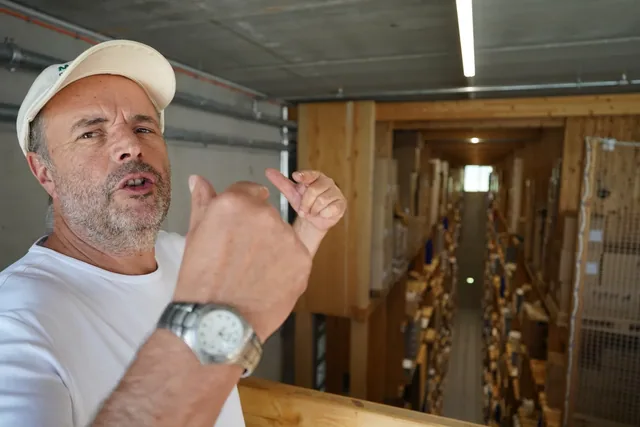
Many local craftspeople worked on the building site. For the two sons, Jakob and Paul Schwarzmann, it was important to do as many of the steps as possible themselves – including three hundred doors, countless shutters, tables and benches made of local wood. Not only to save on building materials that have become outrageously expensive – it is also good for the climate, in the valley and for the family ties. The orders and the value creation stay in the loop, the supply routes short. And so the Berghaus was finished in less than a year of construction.
“Of course in line with spatial planning"
Georg Schwarzmann
The Berghaus Schröcken, newly opened in 2022, on the L200 to the Hochtannberg Pass
This New Year’s Eve, Steffi and Georg Schwarzmann can raise a glass as a business couple and as parents. In 2022, together with Isabelle (12), Lorenz (17), Paul (22) and Jakob (25), they made their dream come true. They have created a “base camp” for people who love the mountains as much as they do. “Families are especially welcome – in the Berghaus, which is not called a mountain hotel,” Jakob stresses. Mountain lovers should feel completely at home here and enjoy life in the mountains to the full. “We did not want to build just any old hotel.”
A base camp with comfort
A restaurant and a sauna area with an outdoor pool nevertheless offer the expected comfort. Jakob is currently fitting out his own flat on the ground floor for himself and his girlfriend Julia from Dornbirn – the guests live on the three floors above. His record collection is already in place. Lorenz, his youngest brother, has only just helped him install the record player and speakers. Just as they help each other with almost everything else up here, in the village with its four associations: fire brigade, mountain rescue, brass band and, opposite, the church.

They were there only recently for All Saints’ Day, in the parish church of the Assumption of Mary. And in the cemetery around it. The village church was packed, everyone knows everyone. “Somehow we are all connected here,” says Steffi. “A real village of club enthusiasts.” “We are active everywhere, in several associations at once,” Paul agrees – like Jakob a state-certified ski instructor. And a joiner, of course.
Together you are stronger – that principle is meant to stay. And it shows in Schröcken. Not only at performances in the summer months, such as by the children’s traditional costume group; even in deep snow the 200 inhabitants of Schröcken know they are well prepared. For ten years the village has been connected to the Arlberg ski area via the “Auenfeld-Jet” over to Lech, close to the Batzenalpe, which ended its season in autumn. The alpine dairymen have taken down their fences ahead of the expected snow, and the “Dorfabfahrt” village run will soon be groomed by the municipality – only the snow is still missing.
Waiting, praying and hoping for snow. The Schwarzmann family is ready for the winter season
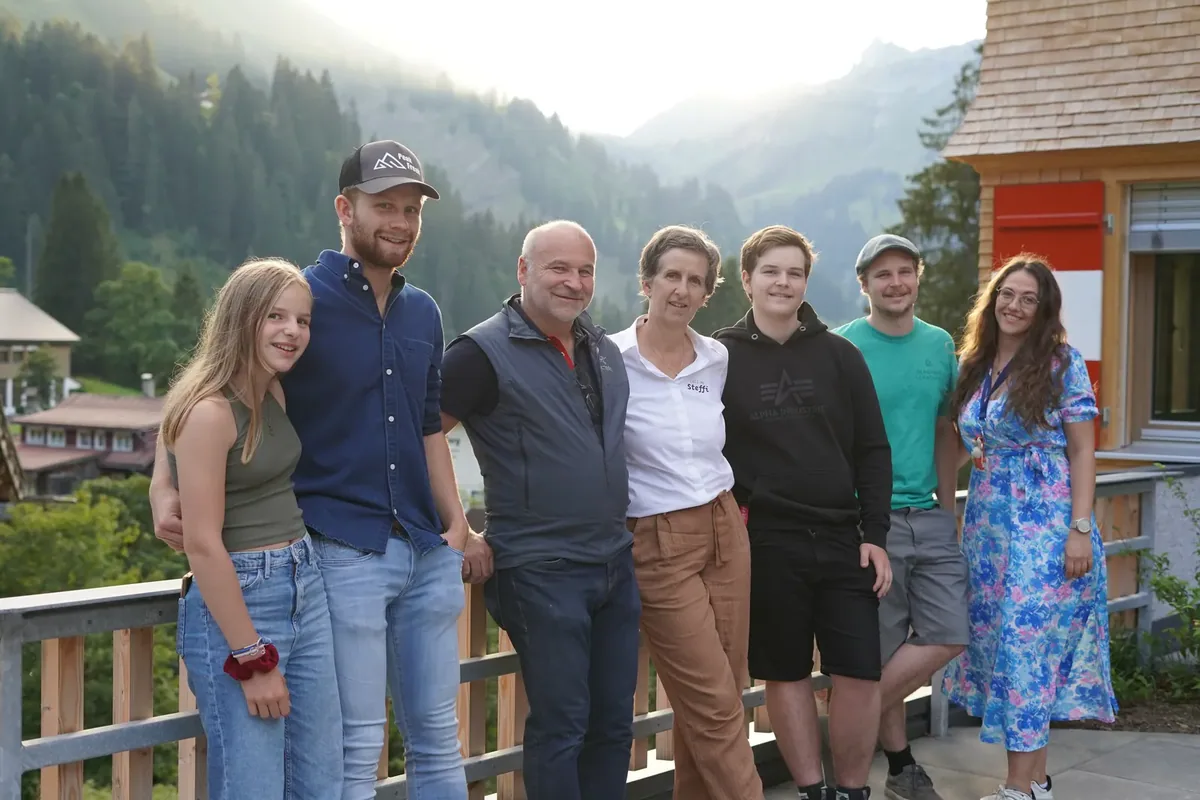
Tourism accounts for only forty per cent, just as much as crafts, including joineries such as the Schwarzmann family’s – they cover both. Father Georg is immensely proud that the tradition is being continued with two more joiners in the family. The remaining ten per cent of value creation in the Bregenzerwald comes from agriculture and livestock farming. That is what kept their grandparents’ generation going too, Georg reports. There was not much in the way of leisure activities back then, though – in what is now Austria’s largest interconnected ski area. “They climbed the steep slopes around the village with skins on simple ash skis.”
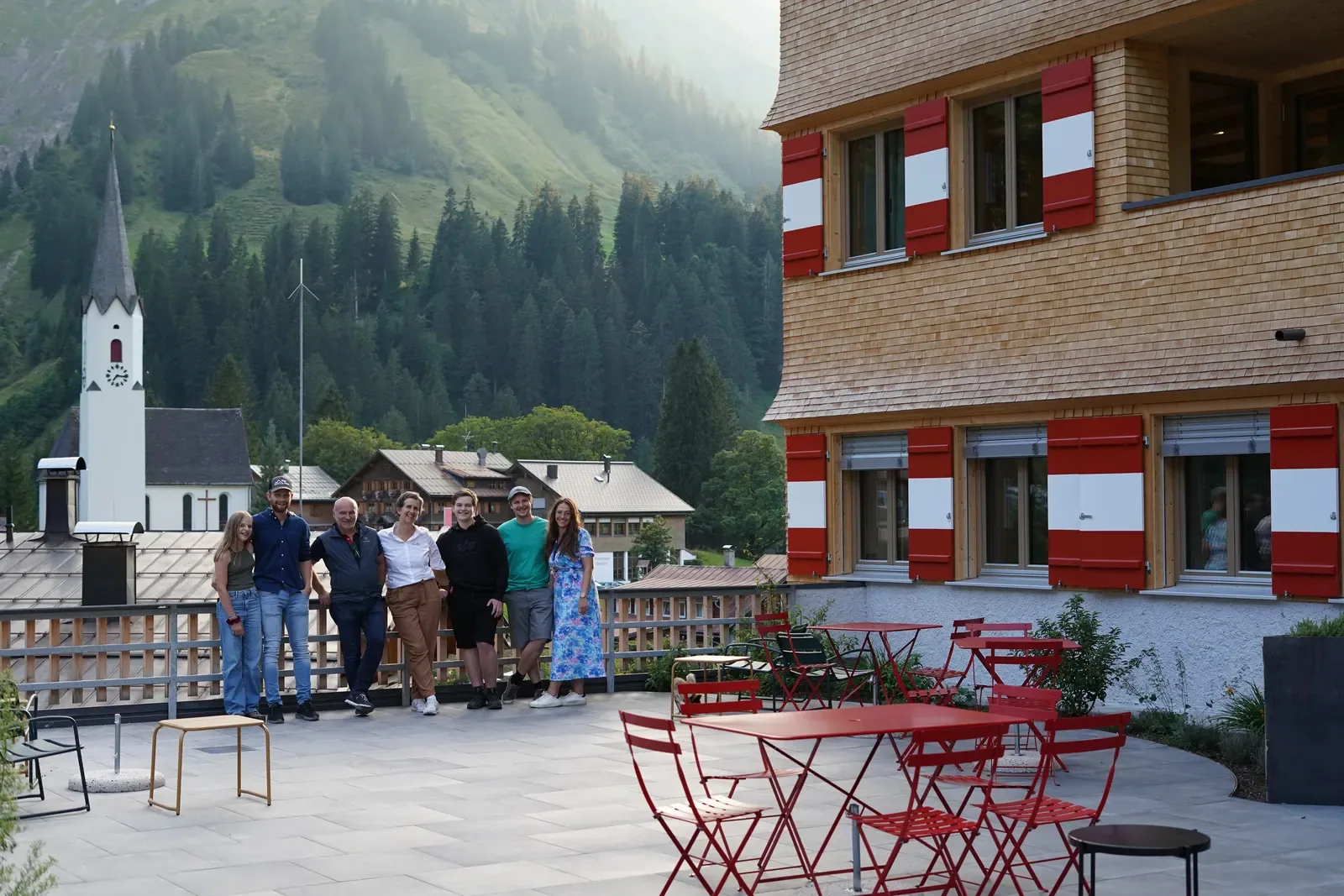
The Schwarzmann family: Isabelle, Paul, Georg, Steffi, Lorenz, Jakob with his partner Julia (from left to right)
Falls on the way to a boom
There were some exciting falls, but also a lot of fun, says Georg Schwarzmann. His grandfather Alwin, who founded the Schwarzmann joinery 100 years ago, volunteered on the municipal council and was a founding member of SC Schröcken. He was in the guild association for over forty years and even served as deputy mayor for a time. Traditions are important up here. And have been for more than 600 years. In the 14th century the Walser came here, an Alemannic ethnic group. And their paths, buildings and stories are still visible today in families like the Schwarzmanns, their friends, relatives and business partners here in the Bregenzerwald.
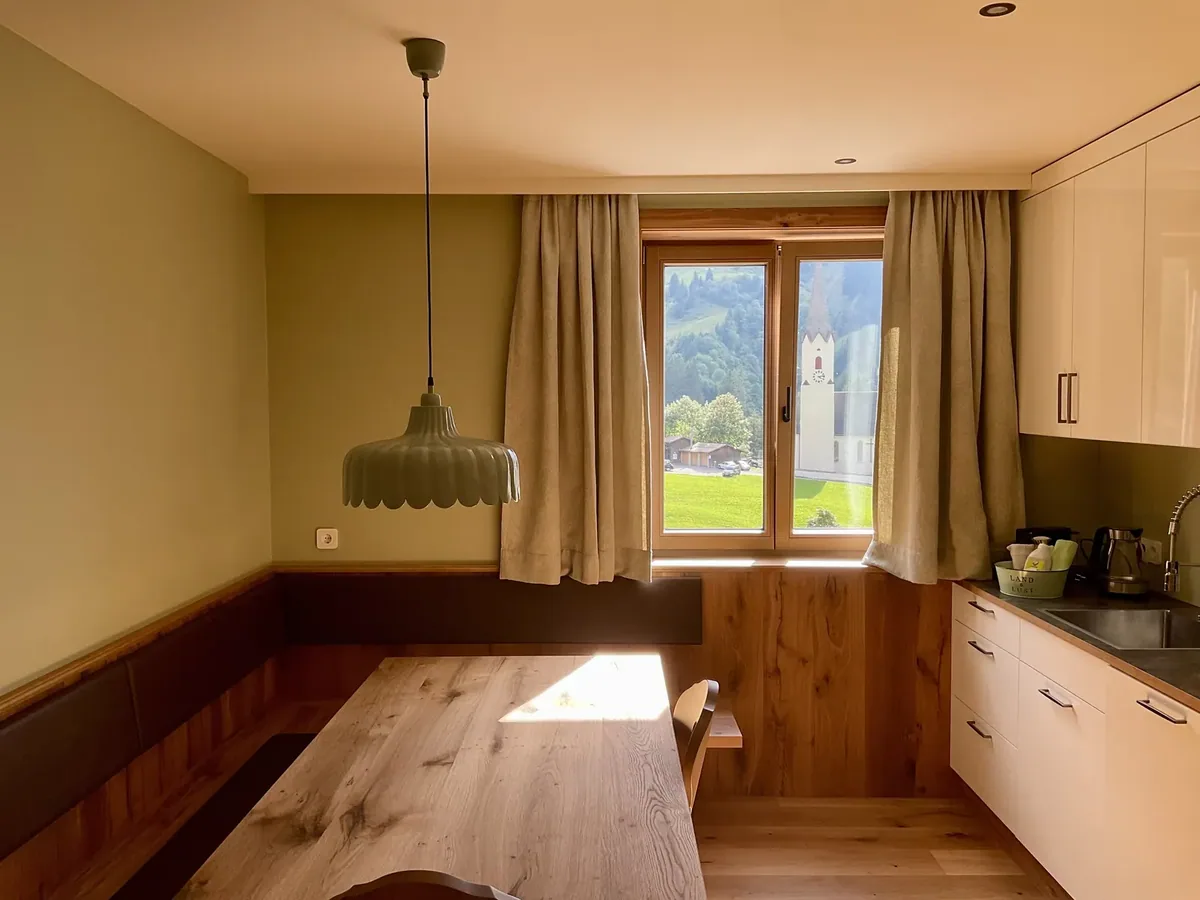
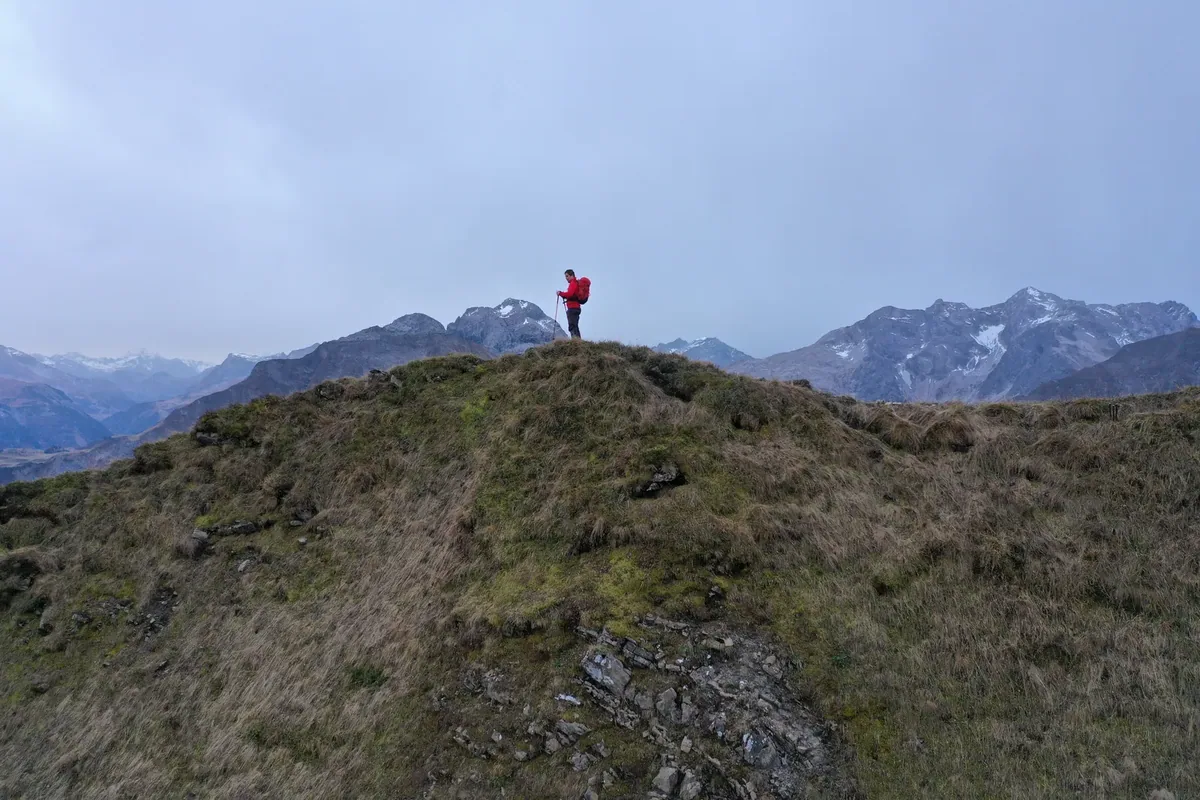
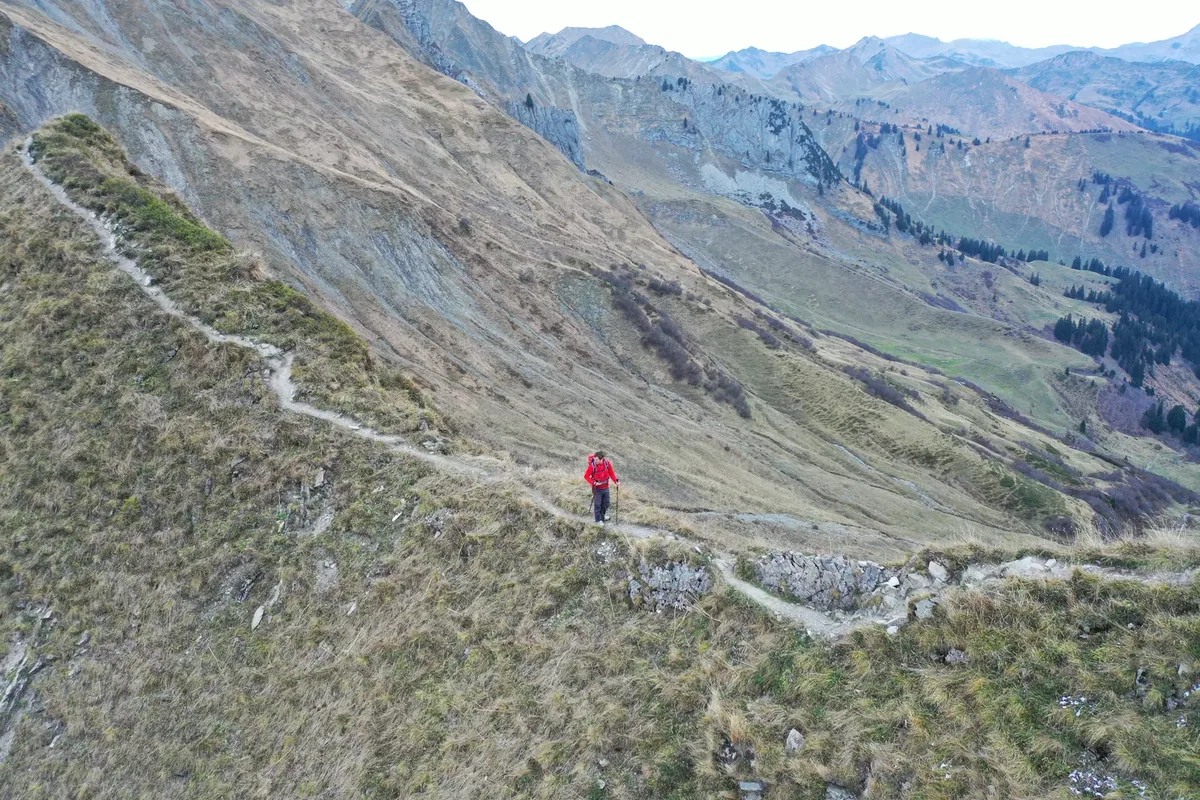
The Schwarzmann family’s favourite spot in their new home is right in front of the main entrance, next to a large sandpit. Their gaze wanders from the drinking-water fountain, past the apartment complex, beyond the tip of the church tower. Behind it rises the Hochberg, a grassy peak among the “Seven Summits” around Schröcken, to which hiking guides like to accompany guests – on their search for grounding, nature’s cycles, mountain herbs and the odd family tree. And of course a fast village run on skis.
“Mountain competence matters to us”
Steffi Schwarzmann
“Mountain competence matters to us,” they say at Alwin’s regulars’ table. The “Wälder”, as people here call themselves, are getting ready. They are preparing for times of greener mountains, even in winter. The high glacier on the Mohnenfluh, visible from far away, is barely recognisable as a snowfield in summer any more. The Schwarzmann family is ready for its first winter season.
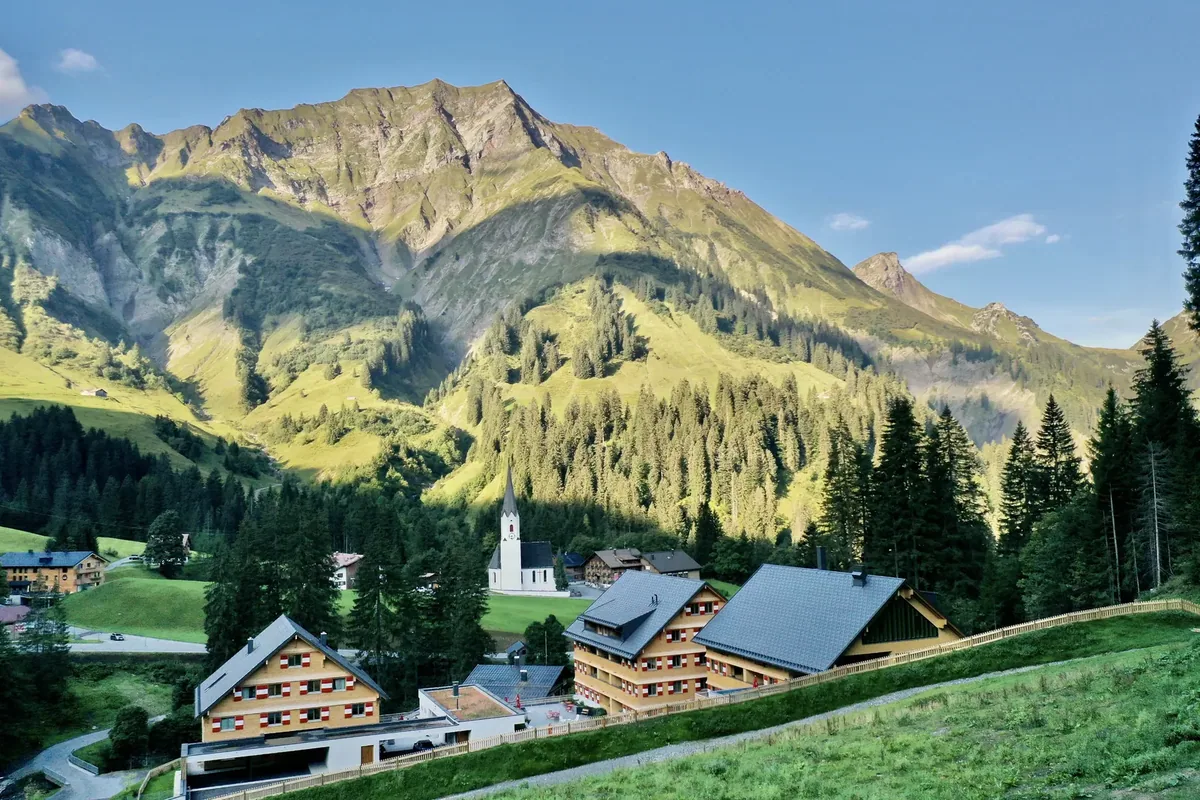
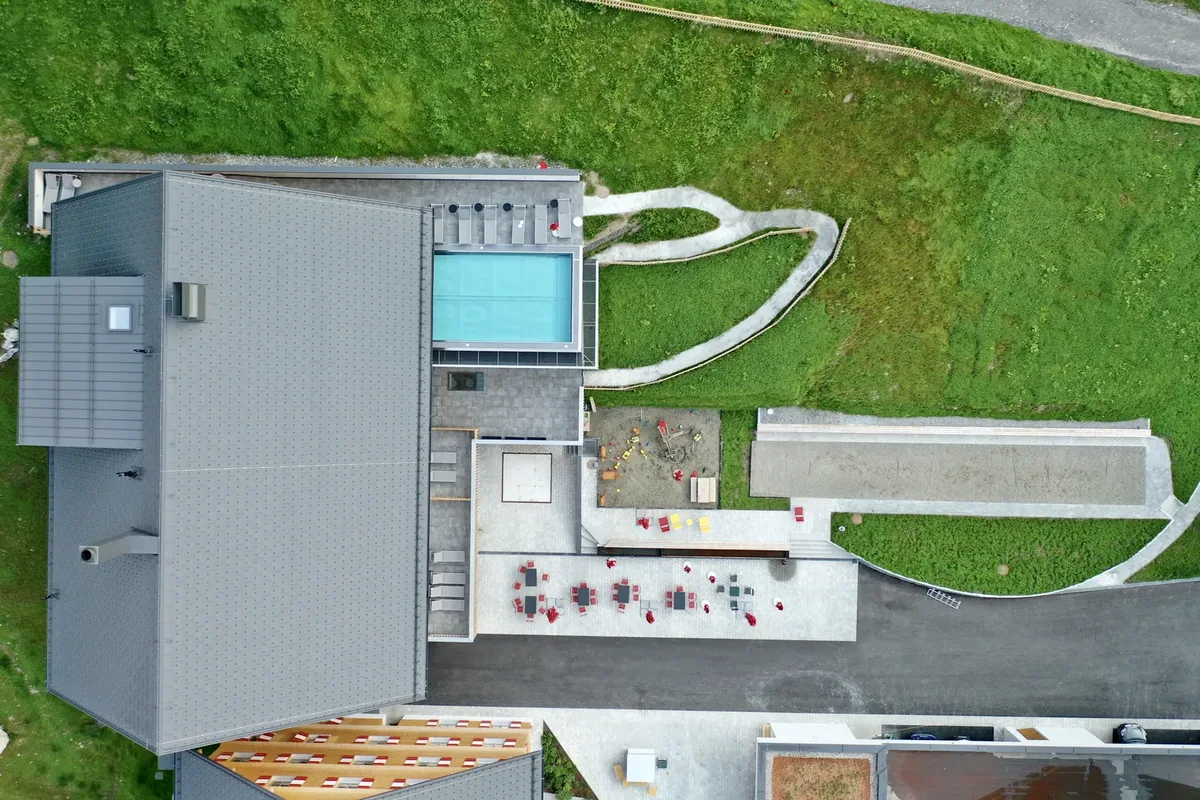
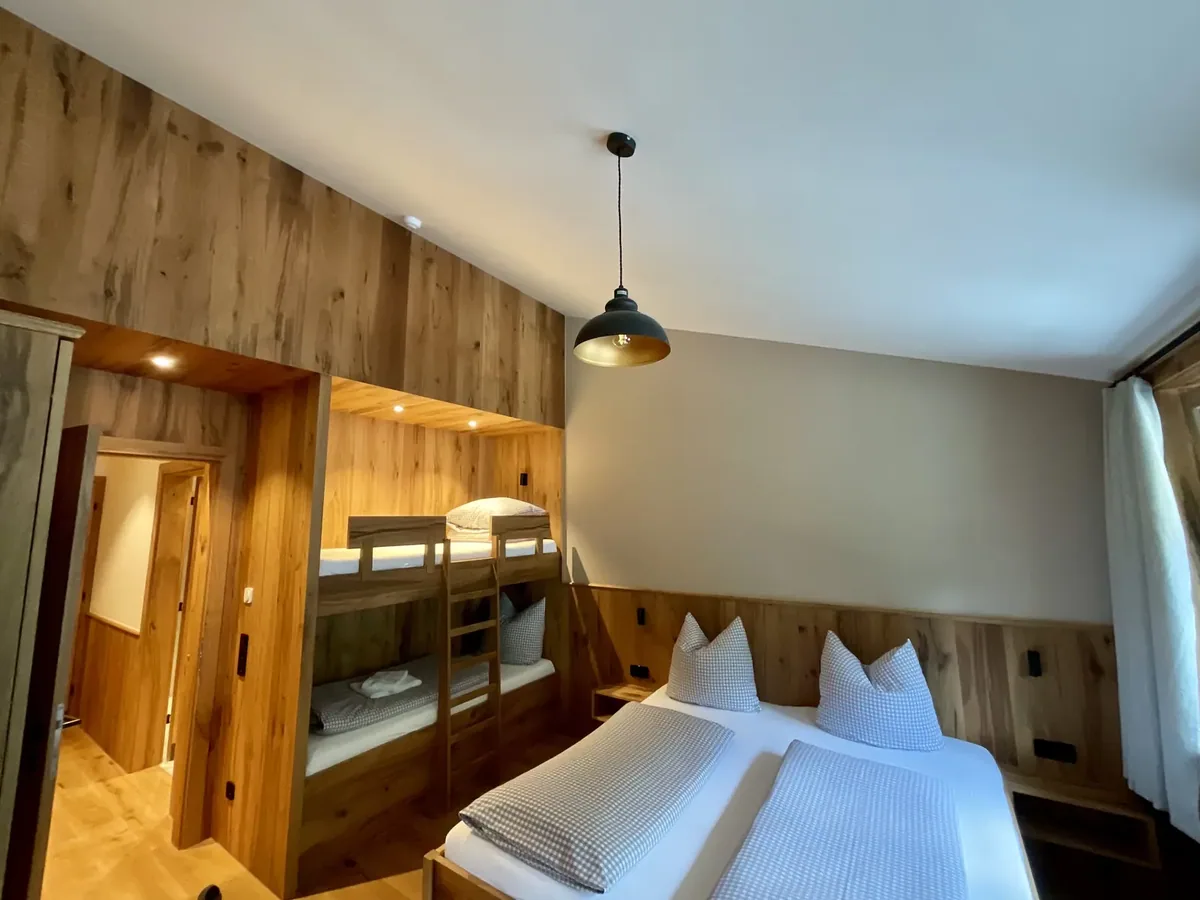

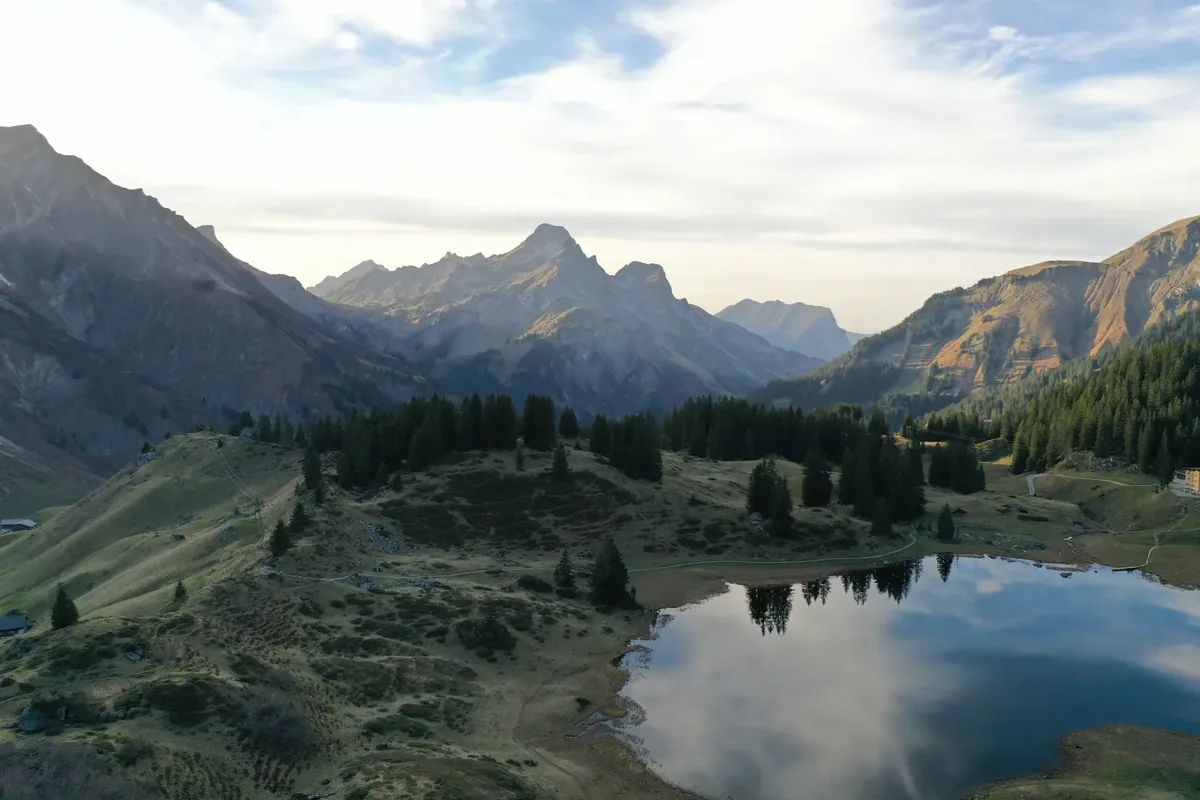
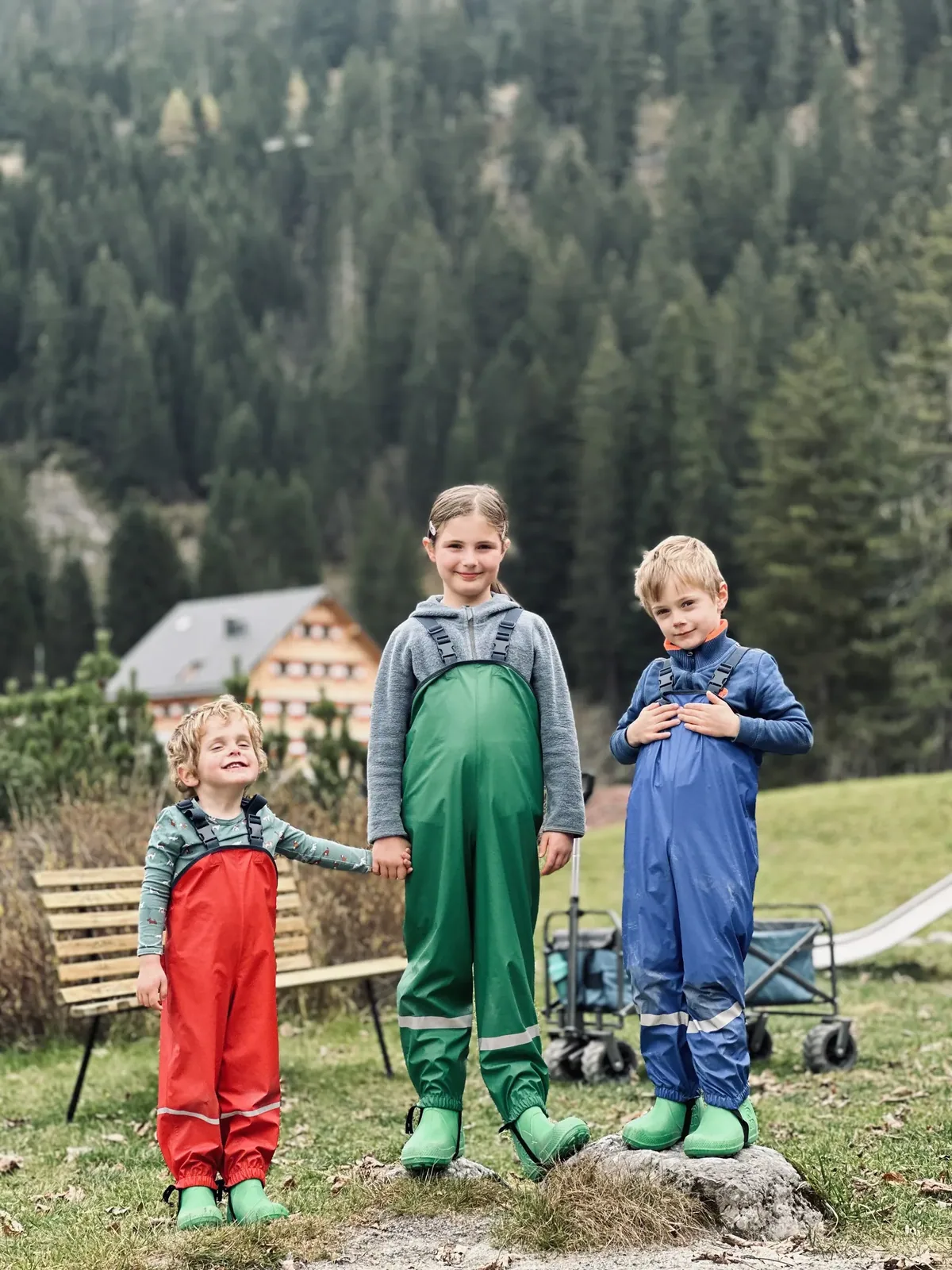
Now, at the beginning of November, light to moderate snow and rain are falling from dense clouds. At last! After the warmest October since records began. And with a World Cup ski race planned in neighbouring Lech for this weekend (12/13 November). Whether it can go ahead is not yet certain. But the snow depots are full and the cannons for artificial snow are ready. The snow line is now at 1,300 m, just above the Berghaus. Things can get going. The Schwarzmanns and their staff are all set for their first season start as the Berghaus team: “We are ready.”
With more than a hundred beds, the Berghaus Schröcken is one of the larger places to stay in the Bregenzerwald. Opening offers for the winter season online: https://www.berghaus-schroecken.at
And here once more is the conversation in their own words:
Welcome to another edition of “In Ottes Ohr”, the tech theologian’s podcast. I am Jan Thomas Otte and I live where three countries meet on Lake Constance. As an expert in digital ethics and sustainability, I accompany people in special moments. Processes of transformation. In my practice as pastor of a city church, just as before as an interim manager in technology and outsourcing. In this podcast I talk to wonderful people, experts in change, personal development and an eye for opportunity. I interview coaches and consultants and invite you to discover very different walks of life. To change your own practice here or there, in everyday office life and elsewhere. And now, enjoy listening!
How did it all start?
The idea actually started out completely differently at first. Namely, that I wanted to settle in Schröcken and build my livelihood on that. And so on. The first plan was simply to build a house. From the start, the idea in the back of my mind was also something with guests. I already wanted to be a host, and then we planned all kinds of projects... Well, that was not really what I was looking for yet. Something was still missing, and Mum was all fired up about the project anyway. And then all of a sudden she brought her ideas in too, and so the whole thing slowly grew into what it is now!
I find it hard to describe what exactly it is, but it is not a normal hotel. So what is it?
In terms of concept, it is actually an apartment house with a restaurant area. But that is not how we want to present it either. We want to convey that more friends are welcome here, that it is a meeting place for mountain lovers. Hence the name “Base Camp”. Because you should meet there, go out during the day and then come back here again. Then spend a nice evening, eat and drink together, and the next day get up again and enjoy the mountain experience to the full – that is it. That is actually the goal of this house. And it also matches the idea I originally had.
A family business...
My grandad founded it 100 years ago as well. A joinery. So our company already has a tradition, and of course I am glad and proud that they are working with us. Yes, it was a stroke of luck that we got hold of the plot. My wife simply has a knack for it. She really knows her way around tourism. Before that, she always did the joinery’s bookkeeping and payroll on the side.
About ski tourism here – it is 50, 60 years old!
A big step, of course, came when the connection to Lech arrived, the second one, that is, when mountains were added years ago. And you could of course feel that in the letting business; things simply went better. And the other thing came too, of course. Investors discovered us, and that has two sides. Back then it was decided that a certain number of beds should be reached. And no cold beds,
What is it called: tourism specialist or travel agent?
I was head of a tourist office in Ward. That is how I came to this region and then, in the end, stayed. And at my age you do not start a hotel. That is why I say that was the idea. The young ones’ idea, they had been thinking about it for a long time and working on it, and when you live in a tourist region, your head is of course always on the subject. And whenever a hotel is built somewhere, you think about how you would do it. Or, well, you are constantly involved and over the years and decades you give it a lot of thought. And when a concrete project suddenly comes up, then of course you have something to contribute in terms of ideas.
How should I picture your decision: we are going to start building?
I mean, one thing was an impulse. Let us do something. Apart from the fact that you want to build a house here, start a family and so on – that is good, not everyone wants that. But nice. A hotel runs for decades. So how are decisions made? With us it is officially still a matter for the parents. Then it will be handed over...
The family as a construct. Is it grassroots democracy, which takes longer, or a bit dictatorial? There is, after all, someone on the edge of Europe who says this is how it is done – or does the family council do it? Have you formalised it in any way? I ask myself these questions too, with three children. It is also a kind of enterprise...
Here the first idea for this project came about more or less as a joke, and everyone contributed their ideas, and then we did reach a point where we said, now we have to seriously ask whether everyone really wants this, with all the consequences something like this really has, because you cannot just take off overnight or quickly change jobs. And of course we tried not to put too much risk on the young ones. They have to commit. But it is also the case that a property like this has value and keeps or increases its value, does it not? That is the safety anchor you have, of course.
And the investors?
That is actually good again at this point, having investors. We financed it with the bank. Yes, and the bank looks closely too. They ask a great many questions. A nice idea, if you are already thinking about something, that there is substance behind it. And, if need be, an exit.
A “happy place” here?
Well, I find the spot outside the most beautiful, especially when you stand between the buildings and look towards the church and up to the Hochberg. And when the fountain, our village fountain, is splashing and people come home and feel there is something to tell each other. People come home – we go home, not back to the hotel.
But it is also special, with this exposed aggregate concrete, the contrast. Did you get inspiration anywhere? On the way here I saw great bus stops, the Werkraum Andelsbuch, where you got your chairs from too – you naturally drew inspiration. Is there some kind of style you took as a guide? Or did everyone in the Schwarzmann family collective and related friends feed ideas into it, like an ideas pool? After all, someone always has to decide...
Yes, we did. It really is a completely new building. But at some point it got to where we could always discuss everything through.
Very last question. Three associations in the village. You have a lot to do.
That is actually the nice thing: you have rehearsal and then you go for a drink together, and there the teenager really sits together with the almost-pensioner, and you drink a beer and have a gentle discussion. The band normally has rehearsal every Friday. I play the drums. Yes, I love doing it.
You have been listening to another edition of “In Ottes Ohr”, the tech theologian’s podcast. How are you leaving this episode? Inspired? Was there something illuminating in it for you? Which fascinating people should I definitely interview next? Praise or criticism – leave us a comment. By email in@ottesohr.de and follow us on the “social networks”. I am Jan Thomas Otte, expert in digital ethics and sustainability. And if you liked what you heard, leave a like. If you would like to hear this more often, simply subscribe. Until next time!
Photos: Jan Thomas Otte
Translated from German by Claude. The episode audio is in German. Read the original in German.