#quantifiedself: Measuring our bodies. And what the digital urge for self-optimisation does to us…
Listen to this episode
Also on: Spotify · Apple Podcasts · podcast.de
We collect data non-stop, whether with a smartphone, a watch or other “wearables”. We let ourselves be fascinated. We learn more about ourselves, our steps, our very own sleep patterns, new eating habits – in real time. But one question remains in this brave new metaverse. What happens when self-optimisation turns into an addiction, an obsession? And how do we get out of this vicious circle again when we keep setting ourselves ever higher goals…
Deborah does not have a smartwatch and never has. She would get herself one as a birthday present, though, just to try it out. With very few apps, however. It is none of her health insurer’s business, not even in a digital patient record. “They can keep relying on my own information when it comes to my movement data,” says Deborah. Most recently she tracked an average of 50 kilometres with her smartphone – “rocked” them, she says – skiing in Tyrol last winter. “Just like that, to see what the baseline is. I do let rip now and then.” Otherwise Deborah is critical of the trend of measuring sport with the help of technology.
Jan Otte: Straight to the crucial question that I ask in all my conversations. Where do you stand on religion?
Deborah Frey: I think religion is something super intimate, something super inspiring, and it can be a lovely guide for people, where they find contact with people who share the same values and feelings. And religion is something very sensitive and very intimate. And yes, that is how I try to see religion and to encounter it.
Jan Otte: Lovely, and as you say it goes very, very deep, very close, really very intimate. You know the subject. You stand behind the camera, but you have also stood in front of it quite a lot, and when the camera’s lens and your own lens meet, what do you feel from one side and from the other?
Deborah Frey: Well, what I love when I am behind the camera, when I am taking photos, is that I get a really great role in a room. Thanks to the camera it really is a special position: I have the excuse to see things and do things and look closely where you would otherwise not dare to. I always say cameras are a super nice excuse for me to keep extending my comfort zone, and I really love that in reportage or when I am travelling. You can simply go round one more corner and you feel – well, you do not have to think about it so much, you just have this lovely different perspective and role.
"Looking closely"
Deborah Frey (as a photographer)
Jan Otte: You mentioned a lovely perspective. Today I would like to talk to you about beauty, ideals and digitalisation too. Certain values are conveyed through Instagram. Not all of it is body-positive. An enormous amount is measured. Do you use a smartwatch?
Deborah Frey: Nope!
Jan Otte: Are you considering it – would it be something you would like as a present?
Deborah Frey: I would definitely wear it.
Jan Otte: Do you find it beautiful?
Deborah Frey: Hmm, no, I am very curious about the function and what my body is doing, and about seeing all of that recorded for once. But I have never reached the point of saying I absolutely want one now, because, well.
Jan Otte: Roughly how often do you look at your phone each day? Of course, for work you are on Instagram. You need that reach, and the internet works very much through images. How often do you look at your phone a day? Do you look at your screen time? It is all listed there. What would you say instinctively? How often do you unlock your screen per day?
Deborah Frey: Oh God, far too often! Okay! I need to take myself to task more often and not fill that one minute...
Jan Otte: Yes, I am thinking of a traffic light in New York. There really was a sticker on the traffic light that said: look at the traffic light with your head held high – and the Facebook status you want to check, with your head bowed of course, you can do that on the other side of the street. Yes, treat yourself to these 15 seconds of your life! On to ideals of beauty. I took a look at your stats: height 170 centimetres, measurements 78, 61, 88 – what is what, actually? I am a bit out of the business; what comes first?
Deborah Frey: Bust and then hips. Actually, those are still the older measurements. A bit more has been added, which is fine too.
Jan Otte: That is exactly what I wanted to get to. I once saw an Insta story of yours. You were just talking, straight after getting up, and there was a message I took away, and I thought I would like to have you on a podcast. “I find myself beautiful as I am, without make-up, with my moles.” And if you look more closely and in that direction – did I remember that correctly, or did I just construct it in my head?
Deborah Frey: Could well be. I do not remember the exact moment, the post you mean. But I do show myself without filters on Instagram, because, I mean, we all know how much can be done, and it is nice to see what the starting point is. Especially in this business you also have to look at how much work would still need to be done afterwards. In inverted commas.
Show business, heavy on numbers
Jan Otte: Yes, and the business, show business, really is a tough business too, not only on Times Square, which you have just discovered, but also in Berlin, where you live in the meantime. And so on and so forth – I will skip the bra size and come to dress size 34. Is that still current?
Deborah Frey: 34, 36.
Jan Otte: Okay, you see, you know what has been added – and how does it feel to have a bit more on your ribs?
Deborah Frey: No, that is absolutely fine. I say the body takes what it needs, and I actually stopped smoking. It must have been five years ago now, and of course the body first had to settle down again, and now it has found its new feel-good weight with these measurements, with the weight I have now, and that is absolutely fine as it is.
Jan Otte: A little more on the scales. At the same time you embody ideals of beauty. I find you beautiful too. And how do you keep fit so that it stays that way, so that you feel comfortable? In your body, of course...
Deborah Frey: Well, I am very much into sport. I love skiing in winter. I do like to overdo it a bit. The last time I went, I rocked more than 50 kilometres down the slopes.
Jan Otte: It is a trend to measure and track personal data, health and fitness metrics with the help of technology. People hope it will make them more health-conscious. I am a bit critical about that, because I ask myself, “How do I compare with others on average?” What does that do to you?
Tracking as a first point of reference
Deborah Frey: I always try not to track so much, because everyone’s baseline is simply different. Just comparing it is super difficult, because every person is so different and comes from different starting points – whether it is about checking or about health or sport or success or who you are and how you became that person – these are points of reference. On the other hand, of course, it gives you a little overview of where you stand and whether you are happy with it, or you just want to collect it as information for yourself.
Jan Otte: Really good! So you said straight away that one thing is simply the data to begin with. Real-time data, tracked data. How much screen time you have actually used – you have a feeling it is rather too much. I need to cut down; with exercise it is the other way round. Or maybe do a bit more. Would it help you if you derived a personalised training plan from this data? Would that motivate you, or would you find it rather tiresome, annoying?

Deborah Frey: I think the numbers would annoy me. I find it nicer when I can feel my progress and be proud of it and notice a change for myself in how I feel or in the result of what I do, not in what the app tells me. I have a tracking app for the time I work in one go, because I try to be productive and then actively take breaks. So that kind of tracking helps, I find. But not one that pushes you too much into comparison...
Jan Otte: I would like to continue with this topic – switching off, always just briefly, which can be addictive. The German word for addiction, “Sucht”, contains the word for searching, “Suche”. I believe people search a great deal online too. As someone who says herself that she should switch off a bit more, what are you working on at the moment? Where are you experimenting, and do you perhaps still have withdrawal symptoms? You already have lots of functions on your phone, plus the tracking apps.
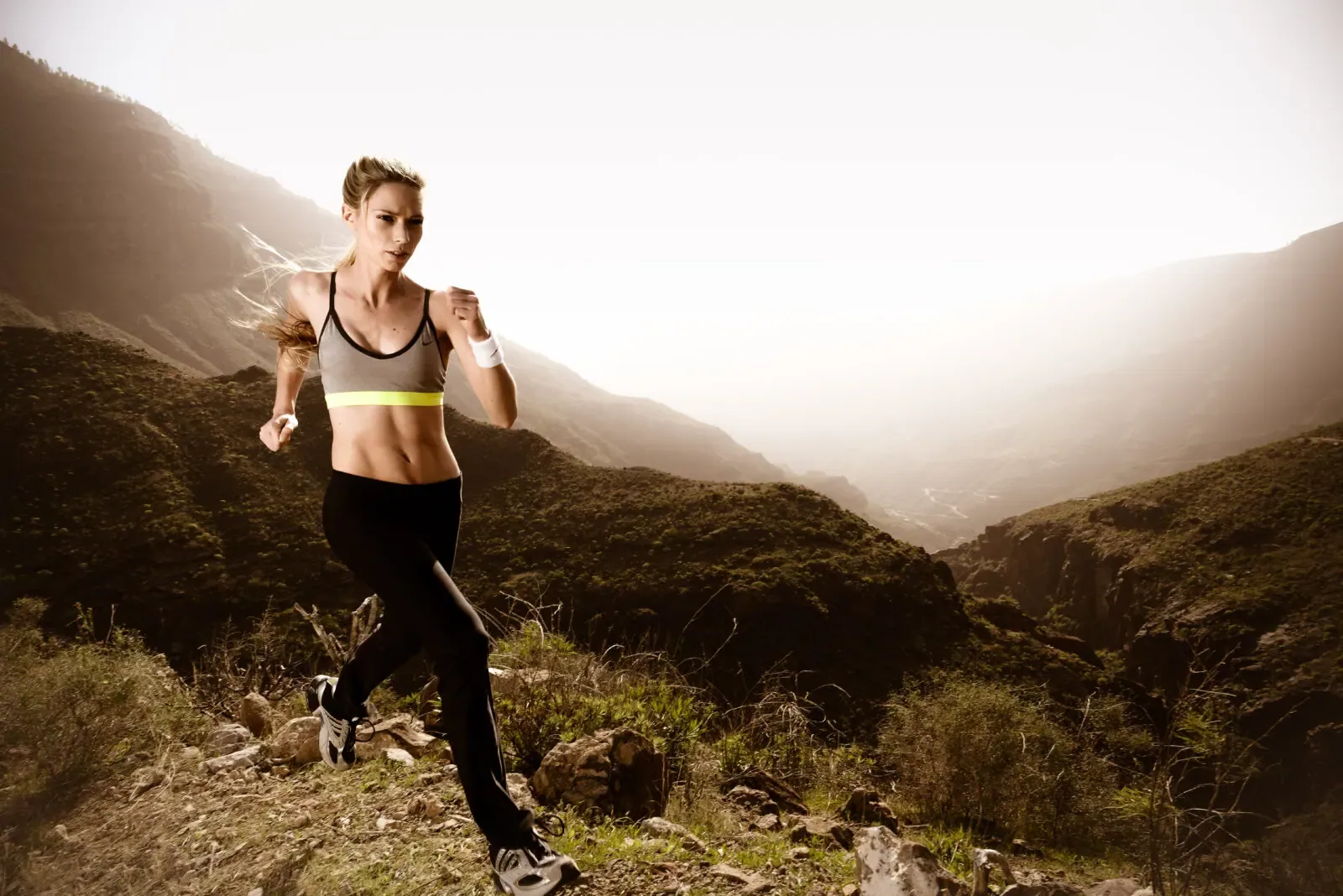
Stretching for the most perfect body possible? Or rather with a filter... (photo: Bjørn Jansen/ Fotografie )
Digital detox can work – for a while
Deborah Frey: I actually had it involuntarily the year before last. Let me go back a bit. I travelled to Vienna, my phone broke, and I experienced Vienna completely offline, and it was wonderful and very inspiring. It was so lovely to experience the city so actively, by working out the evening before where you need to go, what the streets are called, on which corner there is something, because you simply cannot just look it up along the way.
Jan Otte: Without your own phone – I can understand that. Last summer I was boating in Sweden again. Not sailing this time, a motorboat. Still, my phone fell into the water and it is not nearly as waterproof as it says. Two weeks without my phone! And I was unsure. Should I be glad now or keep being annoyed...
Deborah Frey: And how did you feel then?
Jan Otte: I really had withdrawal symptoms. And of course I first googled on my wife’s phone. What to do with bags of rice, airtight in the fridge, condensation. After day two, day three, I went through the “change rollercoaster” and accepted that I simply had to wait two weeks until I was online again. And that there is a great opportunity in that – 14 days without “social media” for once. Back to you. Not everyone listening (or reading) now has modelled or will model, but this constant comparing – I think it affects all of us, and perhaps we can learn something from you there...
Deborah Frey: Well, what I say when girls ask me who also want to go into fashion is: “Take the job seriously, but not the business,” because it is simply so far removed from reality. It is about centimetres, it is simply about these measurements, which, you have to say, have no relevance at all in real life. I only have this one body. It is my home in this world. I am glad I have it, but I cannot change it in that sense, except that I want to live a long and healthy life in this body. We should try to appreciate what we have been given and not let a business talk us into too much.
"The body as a temple of the Holy Spirit"
The apostle Paul
Jan Otte: I have had glimpses into the business. I actually did some modelling myself when I was young. I got to know a little of what it is like to walk the catwalk, the light of the spotlights and the warmth that comes with it – that can be lovely in a way. I swapped that for the stage of faith, in the church. I would like to place a Bible quotation here. You said you respect that. The apostle Paul once spoke of our body as a temple of the Holy Spirit, and I find it lovely that I can, to some extent, be my own temple and that there is also the spirit – and the body, as you put it so nicely, can be a home, but also a shell, and that we should look deeper than what is on the surface, and that is what helped me too.
With my children, who are now growing up with digital media too, I watched Karoline Herfurth’s film “Wunderschön” (“Beautiful”). It brings together different stories, shows show business, eating disorders, this fierce competition. Where do I draw my self-esteem from? And so on – and it moved me a lot, I have to say; I think I even had a little tear in my eye.
Deborah Frey: Ah, lovely, yes. I think I should also say that I was lucky to have worked in nursing first and to have trained there, so I worked very close to life, with life, where it was simply about the other side, about the inner side, about what makes people who they are and how you meet people – not how they come across and what they look like. Because when you work in nursing, you deal with extreme situations and with people who are old, who are injured, who are busy with other issues than any superficialities. And I think that is of course different when you dive into the modelling business very early without having had that kind of contact before, and instead try to gain self-worth from outside, in the visual realm, and not through people, through how you meet people, for example.
Body numbers and vital signs in real time are interesting
Jan Otte: Now you have opened up a whole new field, the care sector. I know it from my grandmothers, who have since died. The care sector. I deal a lot with digital ethics. It really is very, very heavy on numbers, for example care intervals, so many minutes equals so many euros, et cetera. Here in Konstanz we actually had a pilot project at Caritas with a robotics company from Switzerland, deploying care robots with the value proposition of more time for patients (see SWR). Of course you can see there too that it is not only show business that is a very tough business but also the care sector, and how important it is to get yourself into good shape or to preserve an attitude like the one I sense in you. What did you learn in nursing that you would say helped you on the catwalk, or for the next shoot, perhaps even at work?
Deborah Frey: Quite essentially, simply this: if it does not go well, nobody dies – and that got me through many a stressful situation, at university too, however extreme that sentence may sound from the outside. If you make a mistake in nursing, it has a completely different impact from walking badly or a picture not turning out so well. Of course there is responsibility in this field too, where there is a company behind it that generates profits, where employees have jobs. Of course there are big consequences there too, but nowhere near – not at all comparable with working on people or with people, and I think that lightness has helped me rise above messed-up situations or jobs I did not get, or questions about why I was not chosen. Yes!
"How much #quantifiedself is good for me?"
Jan Otte
Jan Otte: Yes, and it is also a field where a lot of (meta)data is collected. That is a constant kind of surveillance too, there as well – as you just said, when things go differently, when mistakes have happened. How do I wind down from that? There are already apps for meditation, for winding down, for switching off. Once again, there is an app for that. The question hanging in the air is how far I want to go. How much #quantifiedself is good for me? Do I really need my sleep to be tracked, or is it not enough to simply sleep...
Deborah Frey: Yes, is it not enough to listen to your body, because it actually gives us all the signals? We have just unlearned it so much. Because we are so distracted by listening to everything that comes from outside, we simply forget to listen inwards. What does the body need right now? For example, I have not drunk any coffee for a few weeks now. I love coffee...
Jan Otte: And the smell of coffee! And now you are in New York and not drinking coffee.
Deborah Frey: Because in the same way, I think, I do not want it from outside; I want to listen to my body again and say, okay, if it needs rest, I will give it rest, and it should find its own energy level again.
Jan Otte: That is a lovely closing word. Simply engaging more with perception again, or the senses. I see, I hear, I smell, I taste – and perhaps simply letting yourself be surprised anew. What does New York smell like?
Deborah Frey: Yes, it is incredibly lovely – I really have noticed many more food smells from the different restaurants here.
Wearables do not solve health and fitness problems
Jan Otte: Let it flow over you, let it sink in, and not everything has to be measured – and who knows, maybe your phone will break again in the next few days. I do not wish that on you, of course, but then you would be fully present with both eyes. What is flowing over me? What are my influences? Where do I draw my self-esteem from? Measuring everything, higher, faster, further – it is no remedy for all health and fitness problems, and I assume that even you, relatively fit as you seem to me, have to overcome your inner couch potato again and again – or what helps you? What got you out of bed this morning, apart from the fact that we had arranged to talk, with a six-hour time difference?
Deborah Frey: Yes, curiosity definitely drove me out. Out into the city, to see what I have not seen here yet, and simply to stroll through the streets. Definitely that. But of course I have a huge inner couch potato – everyone does – but sometimes I simply set myself a little countdown. Maybe that is a good tip for everyone who sometimes struggles to get up. I simply count backwards from five. I think it is a fairly well-known method too, and at one you simply get up.
Jan Otte: Simply get up – and that works without a personal trainer or an app!
Deborah Frey: Yes, and then simply do it, really, yes, yes!
Jan Otte: Really good – just do it! I like that. Go and enjoy this great city, New York City, with your head held high...
Deborah Frey: I will. Thank you so much for your kind words and your time. It was a pleasure to be part of it!
Photos: Bjørn Jansen/ Fotograf
Translated from German by Claude. The episode audio is in German. Read the original in German.