With a smile and a tear: On funerals, grief and hope…
What does a funeral director actually do all day? Anja Rechberg is a funeral director in Konstanz; her great-grandfather already ran a funeral home here. In our conversation she explains why her job resembles a wedding planner’s, why laughing at funerals is allowed and what helps people say goodbye.
Listen to this episode
Also on: Spotify · Apple Podcasts · podcast.de
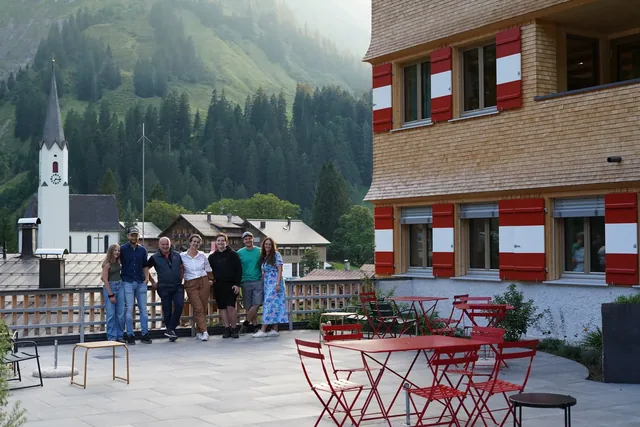
What does a funeral director actually do all day? At the end of November, between the Sunday of the Dead and the first Sunday of Advent, I sit down with Anja Rechberg for a conversation. She is a funeral director in Konstanz; her great-grandfather already had a funeral home here. Before joining the family business she studied at the University of Konstanz and worked in management consulting and at an advertising agency. Today she runs the family business, Wengert Bestattungen, in the fourth generation.
Superlative: Why nobody pretends in the face of death
The best part of her job, Anja says, is the encounters. People sit across from her unfiltered. It is not about how great or how rich someone is, but about the person. “Death is the superlative,” she says; nobody needs to pretend. After a funeral she often hears: “Can I even say this? But it was lovely to meet you.” There is no standard procedure: some want to talk a lot, some not at all.

“Death is the superlative. Nobody needs to pretend.”
Low time, not wedding time: Organisation and pastoral care
Organisationally her work resembles a wedding planner’s – except there are two weeks instead of a year, and the occasion is the opposite of a celebration. It has three parts: conversations with the family, designing the service with notices, cards and music, and finally the paperwork with authorities, pensions, health insurers and insurance companies. She likes that part least. On some days her phone rings 20 to 40 times, and in November she sometimes has to refer families to colleagues because there is simply not enough time.
Cycle: Woodland burial, urn walls and human composting
Around 80 percent of the deceased in Konstanz are cremated. About half of these urns go to a woodland burial site, because nobody has to tend a grave there and many feel more at home in the forest than in a cemetery. Anja does not like urn walls: for her, the urn belongs in the earth, back in the cycle of nature. In the wall it still stands after 20 years exactly as on the first day. And the new human composting (“Reerdigung”)? It is not permitted in Baden-Württemberg. With the trips to North Rhine-Westphalia and back, it is anything but sustainable.
“I feel with them, but I do not grieve with them.”
Compassion: What is hard and what carries you
Hard are the blows of fate that make Anja think: life is unfair. When a child dies, the parents need more time and space, and the service looks different from one for a 90-year-old. She switches off with friends and hobbies, though some things stay with her. Her principle: “I feel with them, but I do not grieve with them.” Only then can she guide families through the difficult days. Should you look at the deceased one more time? Everyone decides for themselves – never under pressure.
Laughter: Be glad of every laugh
At funerals and in her conversations people often laugh, and many are shocked at themselves. Anja tells them: “Be glad of every laugh. You will cry long enough.” The churches have also become more open about music. Besides “Ave Maria” and “Time to Say Goodbye”, she has even had “Highway to Hell”.
“If someone firmly believes that life goes on after death, then death is a little easier.”
Hope: Rituals, faith and a life beyond
What helps with saying goodbye is often very simple: writing down what has remained unsaid, preferably by hand. At funerals Anja likes to hand out small notes on which everyone writes wishes or thanks to the deceased, which then go into the grave. Believers, she observes, find it a little easier to say goodbye. And she herself? “Yes, I do. Definitely. I believe there is something after death.”
For me as a theologian this fits the Sunday of Eternity: we do not believe in death – that is a fact. We believe in the resurrection.
More about Anja: Wengert Bestattungen, Konstanz (in German)
Photos: Monika Grabkowska, Joshua Earle, Getty Images, Frank Flores via Unsplash+
Translated from German by Claude. The episode audio is in German. Read the original in German.